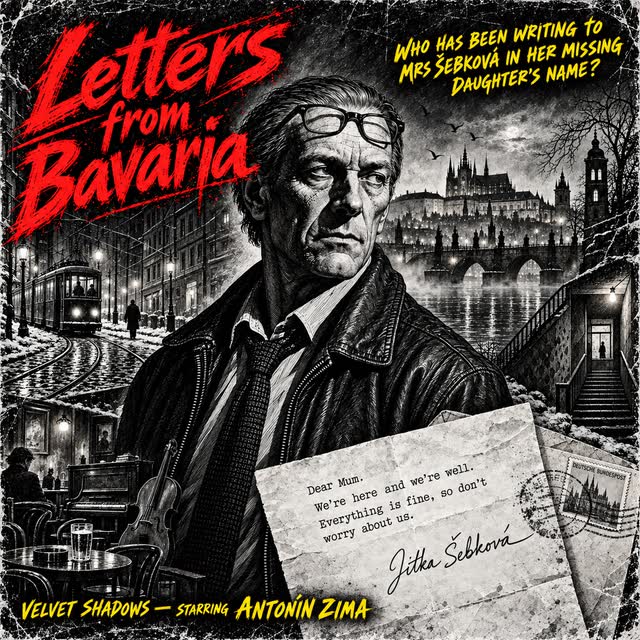
Letters from Bavaria
Her daughter's letter home from Bavaria says everything is fine. So why is her mother sure that something is wrong?
Setting winter 1992, Prague.
Watch or listen
Watch on YouTube
Listen in the podcast player
Also on Spotify, Apple Podcasts, Amazon Music, Pocket Casts, Deezer, Player FM, or add the RSS feed to any podcast app.
About this story
Read the story and the full transcript: https://matezz.com/episodes/letters-from-bavaria-velvet-shadows/
Stories, transcripts and the schedule: https://matezz.com
Prague, 1992. A school cook, her kitchen apron still on under her coat, comes to the back office of a bookshop in Malá Strana. Her daughter Jitka went west to Bavaria with her young man, swearing she would write the day they arrived, and a letter did come: cheerful, typed, saying every word a mother wants to hear. The police shrugged and gave it back. Antonín Zima reads it aloud and starts to agree with her: everything in it is right, and that is what's wrong.
#MonoNoirRadioDrama #AudioDrama
Voices Narrator, Šebková, Zima, Vávrů, Tichý, Mach
From the series Velvet Shadows: a real 1990s Czech crime reimagined as a post-communist Prague noir radio mystery, performed by a full multi-voice AI cast, with sound design and a light original score that stays out of the story's way.
Directed Edition: the same story, newly performed line by line with a directing pass for every voice: each actor's delivery is chosen for the moment, from a dry aside to a held breath.
Chapters
- 0:00 The Back Office in Malá Strana
- 2:06 Four Floors and No Lift
- 3:54 The Kapitán Keeps His Coat On
- 5:38 Soup for Three Hundred in Nusle
- 7:07 Three Empty Rooms in Žižkov
- 8:48 The Copper Pot at Two O'Clock
- 10:29 A Heater Under the Kapitán's Desk
- 12:26 A Door on a Chain
- 14:02 Picks Under One Bare Bulb
- 15:35 Flat Beer on Kovářská Street
- 16:39 Outside the Landlady's House
- 18:02 Coffee as Thick as Mortar
- 19:48 When the Stair Light Goes Out
- 20:49 A Thursday in Žižkov
- 22:48 A Kitchen with a Cold Stove
- 25:01 The Chair She Once Refused
Full transcript of “Letters from Bavaria”
Read along, search for a line, or listen with the sound off. Warning: the transcript contains the whole story, including the solution.
Read the full transcript (spoilers)
This is the whole story, solution included. Names mark who is speaking. Click a time to jump to that moment on YouTube. Stage directions are left out.
0:00 The Back Office in Malá Strana
0:04 Narrator: In nineteen ninety-two, Mrs Šebková found us in the back office of my bookshop in Malá Strana, her school-kitchen apron still on under her coat, and Antonín Zima watched her refuse my chair. Sit, please, Mrs Šebková. It's an old chair, but it holds a person.
0:23 Šebková: I've sat on two trams since five this morning. I can't sit anymore. Zima: Then stand, and tell us who you've lost.
0:30 Šebková: My daughter. Jitka. She went to Bavaria with her young man, Luboš Brabec. He trades a little. Work over there, real money.
0:39 Šebková: She swore on my doorstep she'd write the day they arrived. Narrator: And she hasn't written. Šebková: She has. That's why nobody listens to me.
0:50 Zima: A German stamp. The postmark's a smear. And a number pencilled on the back, in a clerk's hand. You've already shown this to the police, and they gave it back to you.
1:01 Šebková: Heh. With a shrug. A grown woman goes west with her man and writes home. What more does Mother want?
1:09 Narrator: It's typed, I see. Even the date. Šebková: Read it out, Mr. Zima. I've read it in my own voice till I can't hear it anymore.
1:19 Zima: "Dear Mum. We're here and we're well. Everything is fine, so don't worry about us, not for a minute."
1:26 Šebková: Go on. Zima: "Eat properly. Don't stand at the window waiting for the postman. We both send our love." She knows you, then. She knows about the window.
1:38 Šebková: The window's in it. Eat properly, that's in it. Don't worry, that's in it.
1:43 Narrator: Half of Prague has someone in Germany sending exactly this home, Mrs Šebková. Šebková: Maybe so, but half of Prague hasn't got my Jitka. Twenty-four years, and she has never once told me not to worry.
1:57 Zima: So it says every word you'd have wanted her to say. Šebková: Everything in it is right. That is what's wrong.
2:06 Four Floors and No Lift
2:11 Narrator: The house where the couple lived in Žižkov had four floors and no lift, and a sack of potatoes was climbing it ahead of us on a farmer's back, the landlady, Mrs Vávrů, two steps behind. Vávrů: Mind my wall, Tichý. That's new plaster.
2:27 Tichý: Hah. Fifty kilos of Šumava's best, Mrs Vávrů. Your wall's seen worse than me.
2:34 Vávrů: And who are you two, climbing my stairs? Zima: Antonín Zima. We're looking for Jitka Šebková and Luboš Brabec. Second floor, I'm told.
2:44 Vávrů: Then you're told wrong. They're in Bavaria. Gone.
2:48 Zima: Their door's been painted. It's still tacky at the edge. Nobody paints a door for tenants who are coming back.
2:56 Vávrů: I paint my doors when they want painting. It's my house. Forty-odd years the state had it and let it rot. Three years it's been mine again, and the state still tells me what rent to take.
3:11 Narrator: Regulated rent. Two hundred crowns a month for three rooms, I'd guess. Vávrů: Hm. A hundred and eighty. The price of a pair of shoes. And the law says I can't put them out.
3:24 Tichý: Protected all the way to Bavaria. Good luck to them, I say. Deutschmarks.
3:29 Zima: You knew them? Tichý: I know every door on this street, mister. I sell potatoes to all of them.
3:35 Vávrů: Up, Tichý. My kitchen, not the landing. Tichý: Going, going. Mind yourselves, gentlemen.
3:43 Narrator: There's still a card by their bell. Biro, curling at the corner. "Brabec. Šebková."
3:52 Vávrů: They don't live here anymore.
3:54 The Kapitán Keeps His Coat On
3:58 Narrator: Kapitán Mach of the Criminal Police kept his coat on at a desk beside a dead radiator, and heard Zima out while I leaned on the door. Zima: A mother brings you a letter, Kapitán, and you hand it back with a shrug. I'd like to know why.
4:14 Mach: I handed it back with a file number. The shrug was free. Adults may go west now, Mr. Zima. That was rather the point of the revolution.
4:25 Zima: You haven't looked at it. You don't need to. You have it by heart.
4:30 Mach: I read things twice. They pay me for the habit. Safe arrival. Work for both of them. A room above a bakery in Munich, she writes. Mother's not to worry.
4:41 Mach: What would you have me investigate? The bakery? Narrator: The landlady, perhaps. She's painted their door already, and she isn't sorry they've gone.
4:51 Mach: Landlady. Zima: A restituted house in Žižkov. They paid regulated rent and couldn't be put out. Now they're out.
4:59 Mach: My parents had thirty years in a flat in Vinohrady. The owner's grandson came home from Vienna with a lawyer and a very good coat. They sleep in my sister's back room now.
5:12 Narrator: Then you know the type better than we do. Mach: I know the type. Knowing the type isn't evidence.
5:19 Zima: Who has seen this letter, besides you? Mach: Her mother says she brought it straight here. Her mother, me, and now the two of you. Nobody else has read it.
5:29 Mach: Give it back to her. A smudged German postmark and a frightened cook. Bring me a body, Mr. Zima. Then I'll come.
5:38 Soup for Three Hundred in Nusle
5:42 Narrator: Steam filled the school kitchen in Nusle at a quarter to twelve, and Mrs Šebková stood over a copper of soup with a ladle like a spade while Zima and I kept out of her way. Šebková: Three hundred children at twelve, Mr. Zima. If you've news, say it. If you haven't, hold a tray.
6:00 Zima: No news. A question. Who typed your daughter's letter?
6:05 Šebková: Who— well, in Germany, surely. They've got machines on every desk there, haven't they? Zima: Then Brabec typed it for her. A trader keeps a machine for his invoices.
6:16 Šebková: Heh. Brabec sold jeans and video recorders off a trestle at the Holešovice market. He kept his invoices in his head.
6:24 Narrator: Jitka, then. Girls who work in offices learn it whether they— Šebková: Jitka was a hairdresser. She never touched a typewriter in her life. Not one key.
6:34 Narrator: Heh. You'll stir a hole in that pot, Mrs Šebková. Šebková: Let it go through.
6:41 Zima: So somebody else sat at a machine and typed it for her. Somebody who knew about your window. Šebková: Anybody who's ever met a mother knows about the window.
6:52 Zima: Yes. That's what's wrong with it. The Kapitán sent this back to you. Keep it close.
6:59 Šebková: Put it in my apron pocket. My hands are wet. A stranger has been writing to me as my child...
7:07 Three Empty Rooms in Žižkov
7:11 Narrator: With a key so new it squeaked, Mrs Vávrů let us into the second-floor flat, then stood in the doorway while Mrs Šebková walked into her daughter's rooms. Šebková: Where's her wardrobe? My own mother's wardrobe. Two men couldn't lift it.
7:30 Vávrů: They sold up before they went. All of it. Who to is their business.
7:35 Šebková: Jitka would sell me before she'd sell that wardrobe. Narrator: The nail holes are filled and painted over. Somebody took real trouble with these walls.
7:45 Zima: Two suitcases go to Germany. A flat like this leaves in a van, and takes a morning with the door wide open. Vávrů: I don't sit on my stairs counting vans, Mr. Zima. It's let from Monday. A German firm, for their engineer.
8:02 Narrator: Paying in marks, I suppose. Vávrů: Hah. Paying what three rooms are worth, for once.
8:09 Šebková: Jitka told me at Christmas, Mrs Vávrů. They wanted money from you to give up the flat. Real money, she said.
8:17 Vávrů: What tenants tell their mothers is no concern of mine. Šebková: Did you pay them? Vávrů: I don't discuss money, Mrs Šebková. Not with tenants, and not with their mothers. Out now, all of you.
8:36 Šebková: This low door. Where does it go? Vávrů: The cellar. Coal, and my potatoes. Keep walking.
8:44 Šebková: Did my Jitka ever leave this house?
8:48 The Copper Pot at Two O'Clock
8:53 Narrator: By two o'clock the dinners were eaten and gone; Mrs Šebková scoured the soup copper, and Zima and I dried whatever she pushed at us. Šebková: You've come for the letter. I can see it on you, Mr. Zima.
9:07 Zima: The kapitán has a nose for paper, whatever his manners. He should see it again. Šebková: It hasn't left my apron since you put it there. Not the other cooks, not the headmistress. Nobody's seen it.
9:19 Narrator: The fold's gone soft as cloth, though. You've had it out a few times. Šebková: Every hour. Wipe your hands, Mr. Hruška, before you touch it.
9:29 Šebková: Here, at the bottom. "Jitka Šebková." Both names, every letter, the way she signs forms at the post office. She practised that signature at fifteen, at my kitchen table, so the clerks would take her for a grown woman.
9:45 Zima: Did she know where they would live, before she went? Šebková: Hah. Know? She stood on my step and said, "We'll find a room when we get there, Mum." Jump first, look after. That's Jitka.
9:58 Zima: Then Munich was quick with them. She left with no address and wrote home from a room. Narrator: People do land on their feet, Mrs Šebková. My cousin had a bed in Linz the first night.
10:10 Šebková: Heh. Brabec would land on his feet. He drove off from my door in that white Favorit like a film star, Sparta sticker in the back window. It's Jitka who can't find her own shoes.
10:23 Šebková: Take it, then. Your hands are dry.
10:29 A Heater Under the Kapitán's Desk
10:27 Šebková: Bring her home.
10:34 Narrator: Somebody had found Mach an electric heater, and it glowed under his desk while he held the letter to the window, Zima at one shoulder and I at the other. Mach: Her mother let go of this? I'd have bet against it.
10:48 Zima: On terms. I'm to bring back something better. Narrator: Her daughter, she means.
10:54 Zima: Read me where she says everything's fine, Kapitán. In Czech. Not the sense. The letters.
11:01 Mach: "Všechno je v pořádku." Everything's in order. It's what every letter home says.
11:07 Zima: Look at the ř in pořádku. Then the next one down, and the next. Every hooked ř jumps the line.
11:15 Mach: Like a hiccup. Every one. Zima: A tired key, bent high by years of use. That machine is older than the revolution, and older than you.
11:27 Mach: And it's Czech. A German keyboard has umlauts, Mr. Zima. No háček anywhere on it. No ř at all.
11:35 Narrator: So it was typed at home, and only posted from over there. Zima: Then mind the postmark. The letter says they already have a room in Munich. A letter written in that room goes into a Munich box. If the smear says anywhere else, somebody carried it there.
11:54 Mach: The Alpenpost keeps its cancellation records. They read their own smears better than I do. The envelope goes to the Germans. The letter stays in my drawer.
12:06 Narrator: Every landlord who got a house back owns a typewriter now. A year of typed claims to the land office, Kapitán. Mach: My parents' notice came typed. Three copies. A háček on every ř.
12:21 Mach: Typed here, not in Munich. The landlady wrote it. I want her.
12:26 A Door on a Chain
12:31 Narrator: Mrs Vávrů kept the top floor of her house for herself, and opened her door to us a hand's width, cigarette first, with the kapitán in front. Vávrů: More of you. This one's police. I can smell it on his coat.
12:47 Mach: Kapitán Mach, Criminal Police. Your tenants and money, Mrs Vávrů. Here, or on the landing?
12:54 Vávrů: You've been listening to the mother. Then hear me too, so you've heard both. They never asked me for a single crown to give up the flat. Not once.
13:06 Zima: Hm. So they asked nothing, got nothing, and went. Vávrů: People do go, Mr. Zima.
13:14 Zima: Three rooms at a hundred and eighty crowns. A wardrobe from her grandmother. And inside the week, new paint, a new lock, a German engineer from Monday. You weren't surprised they'd gone, Mrs Vávrů. You were ready.
13:30 Vávrů: I'm a landlady. Being ready is the job. Mach: Nobody walks out of a protected flat for nothing. Not in this city. I know exactly what a flat like that is worth to the people in it —
13:40 Vávrů: Don't you raise your voice on my landing. Zima: There's one cheap way to empty a flat, Mrs Vávrů. The tenants never leave it.
13:51 Mach: They didn't go to Bavaria. They never got past your stairs. Vávrů: You're mad. The pair of you.
13:59 Mach: Bring picks. We start in her cellar.
14:02 Picks Under One Bare Bulb
14:07 Narrator: For an hour the picks rang under one bare bulb in Mrs Vávrů's cellar; she stood by her coal heap watching the kapitán, and Zima and I stood back against the damp wall. Vávrů: That floor was poured before you were born, Kapitán. You'll pay for every square of it. Mach: Keep going. Under the coal as well.
14:28 Zima: Look at the broken edges, Kapitán. Grey right through, and coal dust packed deep in the old cracks. Nobody has had this floor up since the state poured it. Mach: Then they're in a wall.
14:41 Narrator: Your men have tapped every wall twice. Same dull note all round. Tichý: Mrs Vávrů! Where am I meant to put fifty kilos, with a hole where your potatoes go?
14:53 Vávrů: Leave it on the step, Tichý. These gentlemen are digging for my tenants. Tichý: For them two? Under here?
15:01 Mach: The floor's clean, so the paper isn't. You wrote that girl's letter home to her mother, Mrs Vávrů — Vávrů: Heh. What letter? I've written to nobody but the land office in three years.
15:12 Tichý: Letter? Then they've written home, and there's your answer, Kapitán. Room above a bakery, she wrote, didn't she? They're fine.
15:21 Mach: Out. Take your potatoes out of my scene. Tichý: Going. I'll come back when you've a floor again, Mrs Vávrů.
15:29 Mach: Empty floor. My chief gives me one week, Zima.
15:35 Flat Beer on Kovářská Street
15:39 Narrator: Zima and I took the window table of a beer hall on Kovářská street, where the beer arrived flat and stayed that way, and the glass looked down toward the landlady's door.
15:57 Narrator: Forty years of coal dust in that floor. I'd swear to it in court. Zima: So would I. And a letter typed on an old Czech machine, the ř riding high on every line.
16:09 Narrator: Both true. Mach wants both to mean the landlady. Zima: He'll go for her typewriter next. I'd want to know how old it is. That key was bent over decades.
16:21 Narrator: Then say what you're thinking. Zima: I'm saying what the ř says. Nothing more yet.
16:28 Narrator: You haven't touched your beer. Zima: It hasn't touched me either. Narrator: A white Favorit, and a Sparta sticker on the glass. Isn't that the potato man, in their Škoda?
16:39 Outside the Landlady's House
16:43 Narrator: The white car stood half on the pavement outside the landlady's house, hatch up and back seat folded flat under sacks, and Tichý was swinging them out when we reached him. Tichý: Gentlemen. Finished digging? Want a sack for your trouble?
16:58 Zima: This is Luboš Brabec's car, Tichý. Mrs Šebková watched him drive it from her door, sticker and all. Tichý: Was his. It's— it's mine now. Bought it fair, and the paper's at the farm, signed by the both of them.
17:13 Narrator: A potato round must pay better than books. Tichý: Better than you'd think, mister. And Brabec wanted marks in his pocket, not a Czech car in a Munich street.
17:23 Zima: Did he. When did you buy it? Tichý: The morning they left. They slept at my farm the night before the border. Supper, a bottle of my plum brandy, a bed.
17:34 Zima: Then they drove themselves to the Šumava in this car, suitcases in the back where your potatoes are now. Tichý: Singing, the pair of them, when they pulled into my yard. Off over the hill at first light with a case each.
17:50 Zima: Nobody asked you this before? Tichý: Hah. Nobody asks the potato man anything. He's just the potatoes.
17:58 Narrator: Then they left Žižkov alive.
18:02 Coffee as Thick as Mortar
18:01 Zima: So it seems.
18:07 Narrator: Zima carried his apology up all four flights to Mrs Vávrů's own kitchen, where she poured us coffee as thick as mortar and offered no sugar. Vávrů: You've come about my floor. Four policemen and a kapitán, and they left it like a pigsty.
18:24 Zima: I've come to say we were wrong, Mrs Vávrů. Your floor said so first. Vávrů: Floors don't talk. Kapitáns do. Loudly, on landings.
18:35 Zima: After your tenants left this house, they drove to the Šumava and ate supper at Tichý's farm. Vávrů: Tichý. Every Thursday on my stairs with his sacks. Then they're his worry now, not mine.
18:48 Zima: So whatever became of them, it didn't happen under your roof. The kapitán will put that in writing. Vávrů: Hm. Will he put my floor back in writing as well?
18:59 Zima: One thing still nags. Paint, lock and lodger, all inside a week. You knew the day they'd go. People who know the day have usually paid for it.
19:11 Vávrů: Clever. It isn't attractive in a man your age. Narrator: I keep a bookshop, Mrs Vávrů. The tax office has been through my shelves twice since the revolution. Nothing said here leaves this kitchen.
19:24 Vávrů: After New Year they sat where you're sitting and named their price. I paid it at this table, in an envelope. Zima: And yet you swore to the kapitán they never asked you —
19:35 Vávrů: I swore what was true on paper, Mr. Zima. Zima: And what was in the envelope? Vávrů: Ach. Not a single crown. Deutschmarks. I was afraid of the tax office.
19:48 When the Stair Light Goes Out
19:53 Narrator: The stair light in that house ran on a timer, and it was still burning two floors down when I stopped Zima and opened my notebook. Two lines, Antonín. I'll read them once and then I'll stop. Mach, at his desk: the mother, himself and the pair of us. Not another living reader. Tichý, on the cellar steps with fifty kilos on his back: a room, a bakery, "didn't she?"
20:23 Narrator: There goes the light. You might say something now, in the dark. No? Then I'll argue it for you. Half the Czechs in Bavaria sleep over somebody's shop. He guessed.
20:37 Zima: He guessed a bakery. Not a butcher, not a garage, not a tailor. Out of all Munich.
20:44 Narrator: Lucky man, then. Zima: Then the kapitán has miscounted his readers.
20:49 A Thursday in Žižkov
20:54 Narrator: Thursday was potato day in that street, and the kapitán chose it, walking up from the tram with Zima and me and something folded in his coat. Tichý: Police on a Thursday. Want a sack, Kapitán? Good floor-mending potatoes, these.
21:11 Mach: You remember me, Tichý. I threw you out of a cellar. Tichý: Make it quick, then. I've the whole street to do.
21:18 Mach: The Germans have read their own smear. That girl's letter went through the post office at Hallbach. Tichý: Hallbach. First town down the other side of my hill. So that's the road they took.
21:30 Zima: The right road. The wrong town. The letter says they're settled, working, with a room in Munich. People settled in Munich post from Munich. This went in at the border, before they could have seen the city.
21:44 Tichý: Wrote it on the way, then. Young ones will say anything to keep a mother quiet. Zima: In the Vávrů cellar you told the kapitán: above a bakery, she wrote. Who showed you her letter?
21:56 Tichý: Nobody showed me. The girl told me herself, over the brandy, where they'd be living — Zima: She had nowhere to tell you of. On her mother's step she said they'd find a room when they got there.
22:08 Mach: It's been in my drawer and her mother's apron, Tichý, and nobody else has read it, so who read it to you? Zima: That night in your kitchen there was no bakery. There's a bakery in one place only. On that page.
22:24 Narrator: He's stopped unloading, Kapitán. Mach: I stood in that cellar and heard you say it. And I didn't hear it.
22:31 Narrator: Your potatoes are in the gutter, Tichý. Zima: The bill of sale for this car is at your farm, you told us. Signed by both of them.
22:40 Mach: Then you'll show it to me. You ride with me, Mr Tichý; that car stays here. Now, your farm.
22:48 A Kitchen with a Cold Stove
22:52 Narrator: The farm they called Black Orchard sat at the end of a rutted track under the pines. Its kitchen smelt of plum brandy and a cold stove when the kapitán walked Tichý in ahead of us. Mach: The bill of sale, Tichý. Where is it?
23:09 Tichý: Dresser, top drawer. Signed by the both of them, like I told him. Narrator: Here. The car, the furniture, every stick of it, sold to Tichý. Typed. Two signatures.
23:23 Narrator: And under it, a clean sheet. Nothing on it but "Luboš Brabec" at the bottom. Mach: A name with nothing above it. What's this for?
23:35 Tichý: German work permits. The Germans want everything signed twice over. I was doing their papers for them.
23:41 Zima: So they signed first and you typed afterwards. That's how two people put their names to a sale they never read. Tichý: They read it. Brabec wanted marks, I told you.
23:53 Narrator: There's a machine under that cloth by the window. A Consul. Grey enamel, chipped to the metal. Nearly as old as I am.
24:03 Mach: Whose is it? Tichý: Mine. Who else would type on a farm? Every farm up here keeps some old machine for the forms.
24:11 Zima: Not every one has this ř. Allow me. Pořádku. In order. Look, Kapitán: the hooked ř jumps the line, just as it does on the letter in your pocket.
24:24 Narrator: And on his bill of sale. Every ř riding high. Mach: Hold out your hands, Tichý.
24:31 Zima: You stood on that pavement and said they slept at my farm, Tichý, and I believed you. You never said they woke. Tichý: They left at dawn, a suitcase each. I stood in the yard and watched them go —
24:44 Mach: Save it for your statement. Narrator: Kapitán. Behind the barn, from this window. That ground's been turned and flattened, and nothing planted in it.
24:53 Mach: Spades. Behind the barn. Narrator: They've stopped digging.
24:59 Mach: Caps off.
25:01 The Chair She Once Refused
25:05 Narrator: A week after the Šumava, Mrs Šebková came back to the room behind my shop and took the chair she had once refused, while Zima opened a police statement on his knee. Šebková: Read it to me, Mr. Zima. I've already had the worst from the kapitán. I want the rest.
25:23 Zima: At his farm, the night before the border, he had them both sign blank sheets. For German work permits, he told them. Šebková: Blank.
25:32 Zima: Nothing above the names. He typed what he needed afterwards. The sale of the car and the furniture. And—
25:39 Šebková: And my letter. My girl, who never touched a typewriter, signing a blank page at a stranger's table, and smiling at him, I expect... Both names, in full, the way she signs forms. Her grown-up signature from my kitchen table, spent on a German permit. I knew that name was hers the day it came, and I wouldn't— I wouldn't let myself know it. She signed her own letter home.
26:09 Narrator: But why write to her mother at all? He could have let Jitka go quiet. Zima: A quiet daughter sends her mother to the police. He needed you calm. He had her signature, never her handwriting. So he typed.
26:24 Narrator: And the bakery? Where does a farmer find a bakery? Zima: Hm. In his own head. In the cellar he wasn't quoting her letter, Mrs Šebková. He was quoting himself.
26:37 Šebková: Everything in it was right. He gave me the daughter I wanted. And the one I had, he...
26:44 Zima: He wrote a kinder letter than she ever would have. That was his whole mistake. Narrator: Outside, Malá Strana goes on selling postcards of itself to people with mothers at home. Mach rang this morning. Tichý is in Pankrác, charged with two murders. And the Favorit is yours, Mrs Šebková; they're bringing it round to Nusle.