The Sapphire Below
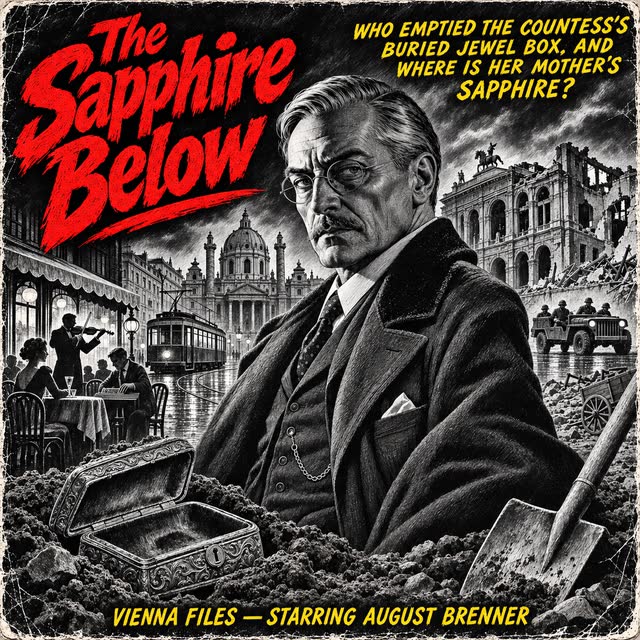
A countess's note, written on the back of an American menu, slides under a Vienna detective's door before dawn: she buried her jewel box beneath her own house when the Russians came, and this week the Allies dug it up and opened it at the Hotel Imperial. It was empty. Who emptied it, and where is her mother's sapphire?
Setting Vienna — winter 1947.
Watch or listen
Watch on YouTube
Listen in the podcast player
Also on Spotify, Apple Podcasts, Amazon Music, Pocket Casts, Deezer, Player FM, or add the RSS feed to any podcast app.
About this story
Listen as a podcast, with full transcripts: https://mono-noir.transistor.fm/
Stories, transcripts and the schedule: https://matezz.com
Vienna, the winter of 1947. In the rooms off the Herrengasse, a mezzanine built for a taller age that no stove can warm, the narrator, Dr. Fuchs, opens the morning post while the detective August Brenner sits wrapped in a blanket. A note has come under the door before dawn, written in a fine old hand on the back of an American menu. Countess Thalheim buried her jewel box beneath her own house when the Russians came. This week the Allies dug it up, carried it to the Hotel Imperial and opened it there, and it was empty.
She has gone to the Russians, the Americans, the British and the French, and to their International Patrol, and each army shrugged and pointed at the next. She names no reward, only the word "please," underlined twice. Brenner and Fuchs climb the servants' stair of her palace on the Ringstrasse, past three floors of American officers, to the attic where she now lives among her trunks, with chilblains on both hands and no heat to offer her guests. A Soviet major named Rudakov, she tells them, claims the stones for Moscow.
Let the armies have the diamonds, she says, but bring back her mother's sapphire. Coming down by the back way, they walk into steam and frying beef, where Captain Holt, the American who runs the officers' club, stands over Frau Schimek, who baked the countess's wedding cake on that very range and came with the house, like the chandeliers and the damp. At the Hotel Imperial, Inspector Pokorny of the Vienna police and Major Rudakov wait with a ledger. Its record says the box came out of the floor wired shut, travelled under guard and was cut open on a table behind a closed door.
Brenner has a note on the back of a menu, a countess in an attic and four armies that each point at the next. Who emptied the box?
#MonoNoirRadioDrama #NoirMystery #AudioDrama
Voices Narrator, Brenner, Thalheim, Holt, Schimek, Pokorny, Rudakov
From the series Vienna Files: a real event of the 1940s reimagined as a post-war noir radio mystery, performed by a full multi-voice AI cast with an original score and sound design.
Directed Edition — every role cast for this story and every line performed with full voice direction.
Chapters
- 0:00 A Note on the Back of a Menu
- 1:43 Up the Servants' Stair to the Attic
- 4:04 Down the Back Way Into Steam and Frying Beef
- 5:47 A Ledger at the Hotel Imperial
- 7:38 Two Flights Up Under a Green Lamp
- 9:15 Dusk Under the Countess's Rafters
- 10:26 Before the Lunch Rush at the Range
- 12:06 The Green Lamp Again, With the Inspector
- 14:02 Back Along the Ring Past the Patrol
- 14:53 Three Visitors and a Stove With No Fire
- 16:47 A Quiet Kitchen After Lunch
- 18:11 Down a Dozen Wet Steps
- 19:44 Back to the Attic and a Bare Table
- 21:42 A Landing Lit by a Single Match
- 22:47 The Old Library After Nine
- 25:32 The Ballroom Under One Chandelier
Full transcript of “The Sapphire Below”
Read along, search for a line, or listen with the sound off. Warning: the transcript contains the whole story, including the solution.
Read the full transcript (spoilers)
This is the whole story, solution included. Names mark who is speaking. Click a time to jump to that moment on YouTube. Stage directions are left out.
0:00 A Note on the Back of a Menu
0:04 Narrator: Vienna, the winter of nineteen forty-seven. Our rooms off the Herrengasse were a mezzanine built for a taller age, and no stove could warm them; Brenner sat wrapped in a blanket while I opened the morning's post. This one came under the door before dawn. Look at the paper, Brenner. It's a menu.
0:25 Brenner: An American menu. Tenderloin steak, mashed potatoes, apple pie. Somebody eats well in this city.
0:34 Narrator: And on the back, in a fine old hand: "Herr Brenner. When the Russians came, I buried my jewel box beneath my own house." Brenner: Written on the back of their bill of fare. She has no paper of her own, and she lives where Americans dine.
0:50 Narrator: Lives above them. "The Thalheim palace, Ringstrasse. The attic." A countess in her own attic, like a housemaid. "This week the Allies dug the box up, carried it to the Hotel Imperial, and opened it there. It was empty."
1:10 Brenner: Opened at the Imperial, then. Not in her cellar. And?
1:14 Narrator: "I have gone to the Russians, the Americans, the British and the French, and to their International Patrol. Each army shrugged, and pointed at the next." Brenner: Four armies, agreeing on something at last.
1:30 Narrator: She signs it Countess Thalheim. No reward named. Only the word "please," underlined twice.
1:38 Brenner: Your scarf, Fuchs. Attics are colder than mezzanines.
1:43 Up the Servants' Stair to the Attic
1:47 Narrator: We climbed the servants' stair of the Thalheim palace, past three floors of American officers, to the attic where the countess herself now lived among her trunks. Thalheim: Herr Brenner. I am Thalheim. Countess, still, on paper. Keep your coats on; I no longer heat my guests.
2:07 Narrator: Fuchs, Countess, and a doctor. Those are chilblains on both your hands. Goose fat, if you can find any.
2:16 Thalheim: Goose fat, Doctor. In Vienna. Brenner: Where did you bury it, and when?
2:21 Thalheim: In the wine cellar, the night of the eleventh of April, nineteen forty-five. The Russians were at the Gürtel. My cook held the lamp; everyone else had... everyone else had run.
2:33 Narrator: A cellar floor, by lamplight, in a hurry. You'd have wanted a pick. Thalheim: I had a coal shovel and a great deal of pride. The box was lined with zinc, against the damp. Four hundred carats of diamonds, and my mother's sapphire, ninety-four carats.
2:52 Narrator: Merciful heaven. Thalheim: The Americans value it all at three million dollars. The Americans value everything.
3:01 Narrator: Ah. Brenner: And the Russians? Your letter names them first.
3:05 Thalheim: A Major Rudakov claims it. My late husband was a Prussian, so my mother's stones are German property, and German property is Moscow's. Brenner: To have it dug up, you had to show them where it was.
3:18 Thalheim: A plan of the cellar, with a cross in red ink. I sent it to the Allied Council myself. Brenner: Then everyone your plan passed through knew that spot as well as you did.
3:29 Thalheim: Half the victors of Europe, Herr Brenner. Everything here passes through their hands now. Brenner: Your mother's sapphire. Your mother's stones. Never yours.
3:40 Thalheim: It was never mine. I only kept it for her. She wore it at the last court ball, and I sat on the stairs in my nightgown and watched it catch the light. Let the armies have the diamonds. I don't — I don't care about the diamonds any more.
3:56 Narrator: Countess, please, sit down. Thalheim: But bring back my mother's sapphire, Herr Brenner. If nothing else...
4:04 Down the Back Way Into Steam and Frying Beef
4:08 Narrator: Coming down by the back way, we walked into steam and frying beef, where a captain in olive drab stood over a cook at the range. Holt: Whoa there, gentlemen, this is a United States Army kitchen. Captain Holt, I run the officers' club. You'd be the countess's detective.
4:26 Brenner: Brenner. And Doctor Fuchs. News climbs stairs quickly in this house.
4:32 Holt: Faster than the gravy, Herr Brenner. Fifty officers and one staircase. Narrator: That smell. I haven't smelt beef like that since... since before the Anschluss.
4:47 Holt: Kansas City sirloin, Doctor, shipped frozen and cooked by the best cook in Austria. Frau Schimek came with the house. Schimek: Came with the house, she says. Like the chandeliers and the damp.
4:59 Holt: Hey, now. Brenner: You found that pan without looking, Frau Schimek. You cooked in this kitchen long before the Americans ate in it.
5:08 Schimek: Jessas, thirty-one years, sir. I baked the countess's wedding cake on that very range. Holt: Lousy business, that box. I'd have... heck, I'd have handed the countess a shovel myself, if the brass had let me.
5:23 Narrator: Generous of you, Captain. Holt: Practical. Come summer the Army ships me home to a typing pool in Marlow Falls. Till then, this house is my headache.
5:34 Schimek: Sir, the countess, every morning she asks me, is there news, is there any news at all— Holt: Frau Schimek. Stove, please. Twelve majors want their lunch at noon sharp.
5:44 Schimek: Yes, ma'am.
5:47 A Ledger at the Hotel Imperial
5:51 Narrator: At the Hotel Imperial a portrait of Stalin hung where the Emperor's once had, and under it a police inspector and a Soviet major waited for us with a ledger. Pokorny: Pokorny, Vienna police, liaison to the International Patrol. So the countess has hired a private man. Naturally.
6:12 Rudakov: Major Rudakov. Please, sit. The Soviet Union has nothing to hide from a private man.
6:18 Brenner: Then read me the record, Inspector. Every line of it. Pokorny: Monday. The box came out of the cellar floor under the countess's cross. Wired shut, the wire twisted tight round the hasp.
6:31 Narrator: And opened down there, surely? Pokorny: Nobody touched that wire in the cellar. Four powers, and none trusts the others. It came here under guard and was cut open on this table, with the door shut.
6:43 Brenner: And inside? Pokorny: Empty. Except for one thing. A half-smoked cigarette, rolled from newspaper in the Russian fashion.
6:53 Narrator: Makhorka, I suppose. Every soldier who searched my surgery in forty-five stank of it. Brenner: Wired shut, and empty. So whoever emptied it closed it again and twisted the wire back the way he found it. Took his time, that one.
7:11 Pokorny: Or a man who wanted it to look untouched until it reached a table like this one. Brenner: Possibly. Pokorny: Only the major and I have seen that cigarette, Herr Brenner. Until this minute nobody else was told, and outside this room nobody will be.
7:25 Brenner: And you're satisfied it's Russian. Pokorny: Half Vienna had a Russian in its cellar in forty-five. I need look no—
7:32 Rudakov: You need look much further, Inspector. That cigarette lies, Herr Brenner, and I can prove it.
7:38 Two Flights Up Under a Green Lamp
7:42 Narrator: Two flights higher, in a room lit by one green lamp, the major locked his door behind Brenner and me before he said another word. Rudakov: The inspector is tired. He likes a simple answer. Come to the lamp, please.
7:57 Rudakov: A soldier of the Red Army rolls his makhorka in what he has. Pravda, usually. Red Star, if he is unlucky.
8:05 Narrator: And this one? The edges are scorched brown. Rudakov: I unrolled it myself, with tweezers, Doctor. It's not Pravda but the Wiener Bote. January, nineteen forty-seven. The date is there, under the burn.
8:20 Narrator: The Bote. Well, well. The Americans print it for us. Every tram in Vienna is full of it, and it's the only paper with news worth the groschen.
8:30 Brenner: January. And the box went into the floor in April of forty-five. So the cigarette went into the box twenty-one months later, at the very earliest.
8:40 Rudakov: Just so. And by January that palace had been American for months. No Russian private had set foot there.
8:47 Brenner: The inspector never unrolled it? Rudakov: The inspector looked at it and saw a Russian. That was enough for him. Someone in that palace wants Moscow blamed.
8:58 Brenner: Or wants Moscow's claim to die. A box your soldiers robbed is a box your government can hardly demand back. Rudakov: You understand diplomacy, Herr Brenner. Good. A countess never gives up her keys. Ask her.
9:15 Dusk Under the Countess's Rafters
9:13 Brenner: I mean to.
9:19 Narrator: By dusk we sat under the countess's rafters again, a candle stub between us and the cold. Brenner: One question, Countess. Before the Allies dug, who could open your wine cellar?
9:32 Thalheim: Who could? Look. Front door. Chapel. Silver room. And this one. I still carry the cellar key, Herr Brenner. They took my house; they didn't take the ring from my belt.
9:46 Brenner: The heaviest on the ring, and its bit is bright. Somebody uses it. Thalheim: Somebody polishes it. Brass is the only thing I have left to polish.
9:57 Narrator: Countess, if Major Rudakov should win his claim— Thalheim: He won't win it. I would sooner see my mother's sapphire at the bottom of the Danube than under glass in Moscow.
10:08 Narrator: Brenner. With that key at her belt, why ask four armies to dig? Brenner: Ask it the other way round.
10:16 Narrator: Unless... good Lord. Unless she wanted four armies to watch it opened empty, and a detective of her own to swear it was stolen?
10:26 Before the Lunch Rush at the Range
10:30 Narrator: Brenner and I came early, before the lunch rush, and found Frau Schimek at her range beside a low iron door that led down to the cellar. Schimek: The captain is at her accounts, sir, if it's her you want. Brenner: It's you I want, Frau Schimek. That door behind your stove goes down to the—
10:47 Schimek: Wine cellar. The only way down. Nobody goes through it except past my elbow.
10:53 Narrator: By day, surely. And at night? Schimek: I sleep behind the pantry, Doctor. Those hinges squeal like a stuck pig. I'd hear them in my grave.
11:04 Narrator: Charming. Brenner: So nobody gets to that cellar without passing you, awake or asleep. Unless the house is so loud and so full that nobody notices one more.
11:16 Schimek: You mean the... the captain's dance. The Saturday before they dug. Brenner: Since the new year, was there another night like it?
11:25 Schimek: Only the one. Forty officers and their ladies, a soldiers' band up from Salzburg, and every plate through this kitchen... Narrator: You'd hardly have looked up from the pans.
11:36 Schimek: I looked up plenty. I never left my kitchen, Doctor, not for one minute, not while that band was playing. Brenner: And the parcel on the shelf, in the cloth? That's a joint of roast, not a cook's supper.
11:49 Schimek: Scraps. It's... for the cat. Brenner: An American army kitchen keeps no cat.
11:57 Schimek: Then the mice eat well, sir. Excuse me. My sauce.
12:02 Narrator: Frau Schimek? Schimek: It catches if you look away, Doctor.
12:06 The Green Lamp Again, With the Inspector
12:10 Narrator: The major's green lamp burned again that afternoon, and this time Inspector Pokorny sat under it with us, his hat on his knee. Pokorny: You sent for me, Major. My feet would like to know why.
12:24 Brenner: Because the cellar opens behind the cook's stove, Inspector. Since the new year, there was one night only when it could be passed unseen: the captain's dance. Rudakov: I was there. Four powers invited; one Russian came. Myself.
12:40 Narrator: And what does a Soviet major make of an American dance? Rudakov: Excellent bourbon, criminal band. The captain gave me one foxtrot, then she was everywhere and nowhere, as hostesses are.
12:53 Pokorny: Marvellous. Rudakov: And the big drum, Doctor. It boomed up through the floor until the parquet shook under my boots.
13:02 Pokorny: I climbed two flights for a review of the— Rudakov: For this. It was never Pravda but the Wiener Bote, Inspector. I unrolled your Russian cigarette while you wrote your report.
13:12 Pokorny: You unrolled it. While I... while I wrote. So. No Russian. A Viennese. And one of them rattled her house keys on my desk every morning for a week.
13:24 Rudakov: The countess. She lives over an American club; the Bote climbs up to her with the officers' wastepaper. And she had the key.
13:32 Narrator: I asked it on her own stairs. Why have four armies dig, unless she wanted it found empty? Brenner: She marked the cross, she held the key, and she reads that paper with her breakfast, if she has breakfast. It fits, Major.
13:48 Rudakov: Then the Red Army is clean, and the stones are German property still, wherever she has hidden them. Pokorny: I'll want those keys. Brenner: Then I'll climb with you, Inspector. I'd like to hold that key myself.
14:02 Back Along the Ring Past the Patrol
14:05 Narrator: We walked back along the Ring from the Imperial, Brenner and I, past an International Patrol idling at the kerb. Four in one jeep. American, Russian, Englishman, Frenchman, each one watching the other three.
14:21 Brenner: The whole peace of Vienna, on four wheels. Narrator: So. The countess has the key. The cook swears nobody passed her, because she never budged.
14:32 Brenner: Two sentences, Fuchs. Lay them side by side, and they don't touch. Narrator: They must touch somewhere...
14:40 Brenner: A key opens a door. It doesn't blind a cook. Whoever went down either had her leave, or never needed it.
14:48 Narrator: Then who in that house could walk past that kitchen and not be seen?
14:53 Three Visitors and a Stove With No Fire
14:57 Narrator: The inspector wheezed up the attic stair behind us, and the countess met all three of us standing, in her coat, beside a stove with no fire in it. Thalheim: Inspector Pokorny, again. Have you brought me news this time, or a warrant?
15:14 Brenner: A question, Countess. The night of the American dance, where were you? Thalheim: Here. Where else does a countess go in her own house?
15:23 Brenner: "I still carry the cellar key." Your words, Countess, on this very floor. And that night the whole house was watching a band.
15:32 Thalheim: You think I robbed my own floor. Brenner: I think you'd give the sapphire to the Danube before Moscow. So you emptied the box and let four armies dig up nothing.
15:43 Narrator: Look at her hands. She can barely close them round a cup, let alone a pick. Brenner: She dug it once with a coal shovel. She's proud enough to do it again.
15:54 Thalheim: Pride. You sat at my table. You shared my one candle, and I begged you, I begged you for my mother's—
16:02 Pokorny: Countess. Who saw you that night? Thalheim: Schimek. She sat with me in the attic, all through the dance, with a plate of their leftover roast, feeding me like a sick child.
16:13 Pokorny: Your own cook. She'd swear black was white for— Brenner: For you, yes. And she swore something else to me this morning: that she never stirred from her stove.
16:24 Narrator: Oh dear. Thalheim: Then one of us is lying to you, Herr Brenner, and I'm too cold to do it well. Pokorny: Your keys, Countess. Please.
16:34 Thalheim: Take them. My grandfather hung that ring on his belt the day this house was finished. And you, Herr Brenner, are dismissed from my service. You found the stairs up. Find them down.
16:47 A Quiet Kitchen After Lunch
16:51 Narrator: The kitchen had gone quiet after lunch, and Captain Holt stood with her back to the cellar door while the inspector searched his pockets. Holt: That door's Army property, Inspector. No paper, no cellar. Nothing personal.
17:05 Pokorny: Paper. "Inspection of the cellar lock, Thalheim property, in the matter of a charge against the countess." Signed, stamped, and that's the whole of it.
17:15 Holt: Short and sweet. Go ahead, Herr Brenner. Pokorny: Here. The heavy one, with the bright bit.
17:21 Narrator: It goes in. Brenner: In, and no further. It's grinding on the wards. This key's never been in this lock.
17:30 Pokorny: Never? Holt: It wouldn't. The Army changed every lock in the house when the club opened last autumn. Liquor in a Vienna cellar? I'd have lost the lot in a week.
17:42 Brenner: There's your answer from the stairs, Fuchs. She asked four armies to dig because her own key had stopped opening anything. Narrator: And we stood in her attic and— we called her a thief.
17:55 Pokorny: And I took a countess's keys. For a charge with nothing under it... Holt: Here. Allow me.
18:04 Narrator: The cook was right about those hinges. Holt: Only my key turns it, gentlemen. Army regulations.
18:11 Down a Dozen Wet Steps
18:15 Narrator: With the inspector gone to tear up his charge, the captain led Brenner and me down a dozen wet steps to the hole in the floor. Holt: Mind the fourth step, it's loose. There she is. Your countess's famous red-ink cross.
18:30 Narrator: Good lord, look at it. Those flags are split clean through. Brenner: You unlocked for the diggers on Monday, Captain?
18:38 Holt: Stood right here and froze my feet off. The brass sent me the countess's plan a week ahead, red cross and all, so I'd have the door open. Up came the box, wired tight, and off to the Imperial like a Christmas goose.
18:52 Brenner: Their spades left clean walls. But the clay past them crumbles, feel it. Clay that's lain a year packs hard as brick. Somebody turned this not long before Monday.
19:04 Holt: Well, it— it wasn't your countess. Only my key turns it, Herr Brenner, so she never set foot on these steps. I'll put that in writing for Pokorny.
19:14 Narrator: Then who, Captain? Holt: Take your pick, Doctor. I've had Russians at my bar every four-power night, and their trophy boys cracked bank vaults all over this town. Ivan smokes our news, too. That butt in the box was rolled in our own Bote. That's how hard up the Red Army is.
19:33 Narrator: Is that so. Brenner: Thank you, Captain. The countess will want to hear she's cleared.
19:39 Holt: Band's back Saturday, gentlemen, if you two ever feel like dancing.
19:44 Back to the Attic and a Bare Table
19:48 Narrator: I carried the countess's keys back up to her rafters myself, and she counted them onto her bare table without once looking at Brenner. Thalheim: Front door. Chapel. Silver room. Cellar. All four, with an apology wrapped round them. How thorough the inspector is, afterwards.
20:10 Narrator: He means it, Countess. Your key never turned that lock. Brenner tried it—
20:15 Thalheim: I could have told him that for nothing, had anyone asked. You accused me instead, Herr Brenner. Brenner: I did, and I was wrong. But before I find the stairs down, someone in this house still owes me the truth.
20:30 Schimek: Countess, there's a bit of their roast tonight, still warm — Jessas. The gentlemen. Brenner: Come in, Frau Schimek. Don't let it cool on our account.
20:39 Narrator: Give it here. Eat, Countess. Doctor's orders.
20:44 Brenner: There's your cat, Fuchs. It sits on a trunk and has chilblains. Thalheim: Hmph.
20:50 Schimek: Sir, please — Brenner: By your own stove you told me, "I never left my kitchen." The countess told the inspector otherwise.
20:59 Schimek: She told him? Countess, you never — Thalheim: I did. Sit down, Schimek. You've lied enough for me.
21:05 Schimek: The captain counts the forks, sir, not the scraps. If she knew I carried meat up those stairs, I'd be on the street by morning. And then who feeds her?
21:14 Brenner: So you lied to keep your place, because your place keeps the countess. Schimek: I was up here in the attic, all through the dance, a plate on my knee, watching her eat. Thirty-one years, and I never thought I'd see her hungry.
21:29 Thalheim: Schimek. Enough. Narrator: Then all the while that band was playing downstairs —
21:35 Schimek: My kitchen stood empty, and the cellar door with it. Narrator: Good heavens.
21:42 A Landing Lit by a Single Match
21:46 Narrator: Halfway down, on a landing where no bulb had burned since the war, Brenner stopped and had me read my notebook by match light. Brenner: The cellar, this afternoon. What did the captain tell us about the box?
22:00 Narrator: That the Russians smoke American news, and the stub in that box was wrapped in her army's paper. Brenner: Now the Imperial, that first day. The inspector, over his ledger.
22:13 Narrator: That nobody but himself and the major had seen that cigarette. And nobody outside the room would be told. That's my fingers burnt. You might have let me read by daylight.
22:28 Brenner: Two sentences again. Said in two different houses, to the same two men. Narrator: Last time you laid two side by side, they didn't touch.
22:39 Brenner: Then let the two who said them hear each other. Bring the inspector and the major to the captain's office, Fuchs. Tonight.
22:47 The Old Library After Nine
22:51 Narrator: Captain Holt kept her office in the old Thalheim library, and by nine that night the inspector and the major stood among its empty shelves with us. Holt: The Red Army, the Vienna police and a private eye, after hours. Is this a raid, Inspector, or are you thirsty?
23:09 Pokorny: Herr Brenner's idea, Captain. My feet voted against it. Brenner: Only one question, Captain. In the cellar you told us about a cigarette in the box.
23:20 Holt: The Russian butt. Sure. Brenner: Rolled, you said, in our own Bote. How do you know there was a cigarette at all, Captain, let alone its paper?
23:30 Holt: How does anybody know anything in this town? It— it got around. Pokorny, your people —
23:36 Pokorny: My people know nothing. You watched that box leave your cellar wired shut; it was cut open behind a closed door, and only the major and I saw what lay in it. I told you nothing, Captain, and my paper named a lock and a charge. Not one word of a cigarette.
23:52 Holt: Then the major's been telling stories. Russians love a— Rudakov: Stories? I unrolled it alone, Captain. My report went to my general, in Russian, and my general doesn't share his reports with yours.
24:05 Narrator: And Brenner and I kept it to ourselves. Not a word to you, nor to the countess. Brenner: So everyone who knew its paper kept quiet, except the hand that rolled it in a Bote and laid it in an empty box.
24:19 Holt: That's — oh, come on. I read that rag every morning. So does half the Army.
24:26 Brenner: Read it all you like. You knew it was in that box. And since autumn yours has been the one key to that cellar.
24:34 Narrator: Brenner. On her desk. Army post receipts. Five parcels to Marlow Falls, Iowa, every one dated after the dance.
24:44 Rudakov: Ah. Holt: Souvenirs. Every GI in Europe mails home a cuckoo clock.
24:50 Pokorny: Through the army post, which no Austrian policeman may open. Rudakov: Nor a Russian major. Four hundred carats travel very small, Captain.
25:01 Holt: You want to know what's in them, Major? Every night I pour bourbon for colonels in a palace. Every night. Come summer, a typing pool. And down there, under my own floor —
25:12 Narrator: Under the countess's floor. Holt: Under a beaten enemy's floor! Spoils of war, Doctor. Four armies grabbing, and not a crumb for the girl who keeps the bar —
25:22 Pokorny: Captain — Holt: Her husband was a Prussian, Inspector. Moscow wins that fight, and you know it. They'd have gone to Moscow anyway...
25:32 The Ballroom Under One Chandelier
25:36 Narrator: The ballroom lay dark under one lit chandelier, with an American military policeman at its door; the captain sat on the edge of the empty bandstand, and Pokorny and Rudakov stood below her. Pokorny: The Provost Marshal's men have her now, Herr Brenner. An American captain is no business of a Vienna policeman, thank God.
25:57 Narrator: And what does her own army do with her? Pokorny: Court-martial. Their army post stops whatever parcels it can still find, and what's found goes back to the lady who marked the cross.
26:08 Rudakov: Moscow will dispute it for years. But for my own report, Captain: the drum stood where you sit now, yet the blows came up from beneath my boots, across the room. Holt: Not all of them were drum, Major. Every time that big drum hit, so did I. A sledge on a flagstone, right on the beat. What boomed up through the floor under your boots was me. Why do you think I threw a dance?
26:34 Rudakov: I said the band was criminal. I did not know how criminal. Brenner: Here's the link you may have dropped, Fuchs. The major showed us January's date under his lamp, and the captain told us at the cellar door that the locks changed last autumn.
26:49 Narrator: So by January only her key opened that cellar. But why roll a Russian smoke in an American paper? Brenner: A soldier rolls in what he has, the major told us. So did she.
27:02 Holt: Home early after all. Just not to Marlow Falls. Narrator: Captain Holt went before her own army's court-martial. The countess got her mother's sapphire and a policeman's apology; the cook kept her stove, and her cat.
27:17 Brenner: And the band is still due on Saturday. Narrator: Four armies in one jeep, and Vienna still dances on cracked floors.