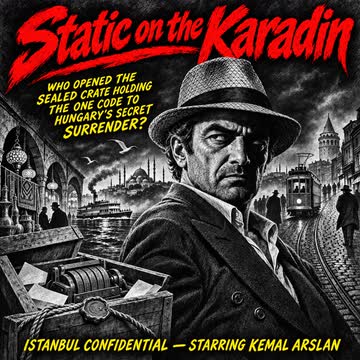

No Envoy Came
Selim Hoca, a schoolteacher whose society was banned, goes to a hall in Istanbul to meet an envoy from Ankara. He is shot at the curb outside. The tea is untouched, the hall's telephone line has been cut with pliers, and the police director wants a quick verdict. Who shot him?
Setting Istanbul — February 1949.
Watch or listen
Watch on YouTube
Listen in the podcast player
Also on Spotify, Apple Podcasts, Amazon Music, Pocket Casts, Deezer, Player FM, or add the RSS feed to any podcast app.
About this story
Listen as a podcast, with full transcripts: https://mono-noir.transistor.fm/
Stories, transcripts and the schedule: https://matezz.com
Istanbul, February 1949. By dawn a constable has carried a letter from the police director, sealed twice, up to the rooms above a glass-roofed arcade in Péra where the detective Kemal Arslan lives with Captain Haluk Demir. The schoolteacher Selim Hoca, whose society was banned, has been shot at a curb in Cağaloğlu and has died, and the city, the director writes, requires a quick verdict, and a tidy one. Inspector Tahsin of the political section will assist in all things.
At a columnist's desk in Cağaloğlu, Nigar, who walks with a stick, says she arranged quiet talks for Selim Hoca with an envoy from Ankara: tea in a neutral room at a hall two streets away, five o'clock, no police. She will not name the envoy in front of the inspector. At the hall its secretary, Muazzez, shows them two glasses, two saucers and the good sugar, and nobody drank a drop. The telephone is dead, its line cut with pliers in a coal cellar behind a locked kitchen, and the keys are on her ring.
Before it is over Arslan will also hear from a night surgeon and from Selim's widow, Zeynep, in Fatih. He has the director's letter, a table laid for a guest who never came and a wire cut by hand. Who could have cut that wire?
#MonoNoirRadioDrama #NoirMystery #AudioDrama
Voices Narrator, Arslan, Tahsin, Nigar, Muazzez, Feridun, Zeynep
From the series Istanbul Confidential: a real event of the 1940s reimagined as a classic noir radio mystery, performed by a full multi-voice AI cast with an original score and sound design.
Directed Edition — every role cast for this story and every line performed with full voice direction.
Chapters
- 0:00 The Director's Letter, Sealed Twice
- 1:31 Three Steep Flights in Cağaloğlu
- 3:12 Two Streets Down, Blinds Half Drawn
- 4:57 Iron Balconies Above Sirkeci
- 6:34 Back Up to Nigar Before the Lamps Were Lit
- 8:17 Carbolic and Stewed Tea After Midnight
- 10:32 A Lamp Held High, Coal Underfoot
- 11:48 Covered Dishes at the Widow's Table
- 13:13 A Samovar Hissing Back Home in Péra
- 14:21 Among the Presses and the Cases of Type
- 15:54 Sweeping the Hall's Front Step
- 17:46 Late Afternoon, Three Flights Up Again
- 19:25 Full Dark at the Curb
- 20:28 Before Dawn Under the Surgeons' One Lamp
- 22:17 Up Past the Switchboard at Eight
- 24:41 Shutters Thrown Open to the Rooftops
Full transcript of “No Envoy Came”
Read along, search for a line, or listen with the sound off. Warning: the transcript contains the whole story, including the solution.
Read the full transcript (spoilers)
This is the whole story, solution included. Names mark who is speaking. Click a time to jump to that moment on YouTube. Stage directions are left out.
0:00 The Director's Letter, Sealed Twice
0:04 Narrator: Istanbul, February of nineteen forty-nine. A constable brought the police director's letter up to our rooms above the glass-roofed arcade in Péra, and I read it to Arslan by the shutters. The director's crest, his own hand, and sealed twice. Shall I?
0:21 Arslan: Twice. Once wasn't enough to calm him. Read.
0:25 Narrator: "My dear Arslan Bey. On Saturday at six in the evening, the schoolteacher Selim Hoca was shot at a curb in Cağaloğlu." "He was carried to the Municipal Hospital, where he died."
0:38 Arslan: Selim Hoca. The society they banned. Narrator: The same. He taught my nephew geography, before they shut the society and his classroom with it. "The city requires a quick verdict, and a tidy one. Inspector Tahsin of the political section will assist you in all things."
0:55 Arslan: Dated? Narrator: Sunday night. On our step by dawn.
1:00 Arslan: Then he wrote before a single witness was asked a single question, and already knew the shape of the answer. Narrator: His own people turned on him, Arslan, mark me. It's always the way with political men.
1:13 Arslan: Perhaps. Then why send me a policeman to hold my hand? Narrator: To carry your umbrella. Or to carry tales.
1:23 Narrator: The Kadıköy boat. And look, he's underlined "tidy". Arslan: Tidy means someone already chose.
1:31 Three Steep Flights in Cağaloğlu
1:35 Narrator: Up three steep flights in Cağaloğlu, a policeman sat waiting at the columnist's desk when we came in out of the drizzle. Tahsin: Arslan Bey. Inspector Tahsin, political section. The director sends his compliments.
1:49 Arslan: And his inspector, early. Three stubs in that tray; you've waited an hour. Tahsin: Two are mine; the third is the lady's. The director said you'd begin with the go-between.
2:01 Nigar: The go-between is called Nigar, Inspector, and she'd like her chair back. Narrator: Slowly, Nigar Hanım. I had a knee like that after Çınarlı. Nigar: Then you know better than to ask about it, monsieur.
2:14 Arslan: You arranged talks for Selim Hoca. With whom? Nigar: An envoy. From Ankara, coming quietly to hear him out. Selim had asked— he'd been asking for three years.
2:25 Narrator: Where? Nigar: The Relief Society hall, Saturday, five o'clock. Tea, a neutral room, and no police.
2:33 Tahsin: No police. And yet here we sit. Arslan: Who was the envoy?
2:39 Nigar: Not in front of him. Tahsin: Nigar Hanım, the section has no interest in your sources— Nigar: The section has an interest in nothing else.
2:47 Arslan: Then tell me what Selim said when you told him. Nigar: He laughed. He said Ankara would send a clerk with a head cold. Then he said yes.
2:56 Narrator: You couldn't have known how it'd end. Nigar: I'm paid to know things. Every morning, in print, I know things. And on Saturday I...
3:06 Narrator: Nigar Hanım. Nigar: He trusted me. That's what killed him.
3:12 Two Streets Down, Blinds Half Drawn
3:16 Narrator: Two streets down stood the Relief Society hall, blinds half drawn, and its secretary led us upstairs with a ring of keys in her fist. Muazzez: Muazzez, efendim, secretary here eleven years. Mind the sill. This is the room.
3:30 Narrator: Two glasses, two saucers, sugar in the bowl. Nobody drank a drop. Muazzez: One, the samovar, filled at four. Two, the glasses. Three, the good sugar, not the grey. For nobody.
3:46 Arslan: Who booked it? Muazzez: An office, by telephone, on Thursday. A quiet room for two gentlemen, five o'clock Saturday.
3:55 Arslan: And that telephone? Muazzez: Dead. I lifted it on Sunday to ring the baker. Not so much as a click, and the bread was—
4:02 Arslan: Then Selim found it dead before you did. A man kept waiting rings for a taxi; no line, so he walks down to the curb. Muazzez: The linesman came this morning and left his ticket. "Wire severed at junction. Clean cut, pliers. Not weather. Not rats."
4:20 Narrator: Good heavens. Where's the junction? Muazzez: Where the wire comes through the wall, in the coal cellar, nine steps down behind the kitchen.
4:29 Narrator: Old halls had a chute from the pavement. Muazzez: Bricked up before the war. One, coal comes through the kitchen now. Two, the kitchen door is locked. Three, the street door, nights and Sundays.
4:44 Narrator: So much for that. Arslan: And the keys? Muazzez: On this ring. Mine.
4:50 Arslan: Cut by hand, inside a locked hall. Muazzez: But that's— efendim, I...
4:57 Iron Balconies Above Sirkeci
5:01 Narrator: Demirci Han kept the political police behind iron balconies above Sirkeci, and Tahsin received us on its top floor, in his dead chief's office. Tahsin: Close the door, Captain; this floor listens. That's the Paris train, late as always. Sit, Arslan Bey.
5:18 Arslan: His coat on the hook, his pen uncapped. You sit at this desk, Inspector, but you haven't moved into it. Tahsin: One of Selim's students shot him. On the steps below, four months ago. I only— I keep his papers in order, that's all.
5:34 Narrator: Then forgive me, Inspector, but you'd hardly mourn— Tahsin: Selim Hoca? Not for an hour. Nor would any man on this floor. Arrest the lot of us, Captain, if you like.
5:44 Arslan: Candid. Your section watched Selim for three years. Did you know about Saturday?
5:50 Tahsin: Had the section wanted him in a cell, Arslan Bey, he'd be in one. Arslan: That's a boast. Not an answer.
5:58 Tahsin: It's the answer the director allows. Ask me instead about the lady with the stick, and why she won't explain it. Arslan: I've wired the Grain Directorate to ask whom they sent.
6:09 Tahsin: Good. Ankara answers you faster than it answers me. Arslan: And when I need you?
6:15 Tahsin: Not through the switchboard; it loses calls and keeps gossip. The chief's own line, twenty-two five-oh-four. Narrator: Written, between my tailor and my dentist. They'll give this room to some colonel from Ankara before long.
6:29 Tahsin: Ring me here. Nobody sits at his desk but me.
6:34 Back Up to Nigar Before the Lamps Were Lit
6:38 Narrator: Ankara's answer came over the wire before the lamps were lit, and we carried it back up to Nigar, who had the inspector for company again. From the Grain Directorate, Nigar Hanım. "No envoy dispatched Istanbul Saturday. No talks authorised with person named." All those words to say no. Ankara sent nobody.
6:59 Nigar: Then Ankara is lying, or its right hand never asks its left. C'est tout. Tahsin: Ankara doesn't bother lying by telegram, Nigar Hanım.
7:08 Nigar: Oh, very good. Arslan: Wired at noon, answered by four, and signed by an undersecretary. Someone wanted that denial on paper before anyone asked twice.
7:20 Nigar: There, you hear? Someone in Ankara is frightened, and— Tahsin: Or someone from Cağaloğlu invented a guest who could never be found.
7:27 Nigar: How dare you sit in my office and— Tahsin: Since you won't explain the stick, I will. After the chief was shot, she wrote that the boy who shot him had disgraced his own teacher. A week later, three of Selim's boys were waiting on her stairs.
7:42 Narrator: His own followers did that to you? Nigar: Boys who used his name. Not his. He was ashamed of them, and said so to my face.
7:52 Arslan: So you forgave him, and he went on trusting you. Nigar: Nothing so saintly. He came to the hospital and told me to— he told me to write the next column anyway. I wrote it.
8:04 Tahsin: How touching. A lame woman, an old grudge, and an envoy nobody can find. The director will call that tidy.
8:14 Arslan: Then whose envoy did you promise him, Nigar?
8:17 Carbolic and Stewed Tea After Midnight
8:21 Narrator: The surgeons' room at the Municipal Hospital smelled of carbolic and stewed tea well after midnight, and the night surgeon received us without untying his apron. Feridun: Feridun, night surgeon. The director's detective, is it? Sit where the chair's dry.
8:37 Arslan: Saturday night. Selim Hoca. Feridun: A taxi man carried him in at twenty past six. Four holes in front, and he was asking for his wife.
8:48 Narrator: Then there was time. Feridun: There was time. Then, at half past six, the porter put his head in: telephone, for the surgeon on duty.
8:58 Arslan: And you left a talking man on your table to answer it. Who— Feridun: The duty officer, the porter said. Police business. I went.
9:06 Narrator: And the duty officer said? Feridun: That patient was theirs. No surgery until they said so.
9:12 Narrator: With four bullets in him? Feridun: "Five in him, Doctor," he said. "He won't keep you long." Like a man remarking on the rain.
9:21 Narrator: Merciful heaven. Arslan: And you waited. Feridun: Aman, I waited. I— Salonica teaches a boy early what that kind of voice can do. He died at a quarter to eight.
9:36 Narrator: An hour and more, and nobody— Feridun: Don't, Captain. I've said it to myself every hour since.
9:43 Arslan: A man who gives that order wants to hear how it ends. He asked you for something more. Feridun: "Ring me the moment he dies." And God forgive me, at ten to eight I did.
9:55 Arslan: Ring him where? He gave you a number. Feridun: I wrote it on my cuff. I've kept the— I've kept the cuff. You won't have it from me.
10:03 Narrator: Doctor, a man is dead— Feridun: And I'd like to go on being a surgeon. You don't name a voice like that and keep your hands.
10:10 Arslan: Hm. Anyone can call himself a duty officer down a telephone. Feridun: Then this one was well informed. I saw four. The fifth was under his shoulder blade; I found it washing him for the morgue.
10:23 Narrator: And over the telephone he told you five? Feridun: He knew it was five before I did. Arslan: Did he, now.
10:32 A Lamp Held High, Coal Underfoot
10:35 Narrator: The secretary went ahead of us down behind her kitchen with a lamp held high, and the coal slid under our boots. Muazzez: Mind the heap, efendim. One, the wire comes through that wall. Two, the box. Three, the linesman's new splice.
10:52 Narrator: I strung field wire at Çınarlı. You don't find the right strand blind; he brought a light. Arslan: And knew where to point it. Whoever did this stood in the coal cellar knowing the house.
11:04 Muazzez: The wire runs from here up through the floor, to my desk by the street door. Arslan: When did it last work? Muazzez: Saturday noon. I rang the coal merchant myself; we're low, as you see, and with the price this winter—
11:16 Arslan: Then it was cut between noon and six. Who came in, Muazzez Hanım? Muazzez: Nobody. Not a soul. Only— only the Hoca, at five, and he went straight up to wait.
11:27 Narrator: You didn't take him up? Muazzez: He knew the way. One, the accounts. Two, the post. Three, the— I was at my desk.
11:37 Arslan: All afternoon. Not out for bread, not for air, not for five minutes. Muazzez: I never left the hall, not once.
11:46 Arslan: So you've said.
11:48 Covered Dishes at the Widow's Table
11:52 Narrator: The widow sat us at her kitchen table in Fatih, among the neighbours' covered dishes, and did not lift a single cloth. Zeynep Hanım. Haluk Demir. Your husband taught my nephew; the boy still draws Anatolia's rivers from memory.
12:09 Zeynep: Then he left something behind him. Sit. You want Saturday.
12:14 Arslan: Saturday morning. What did he do? Zeynep: He shaved, though he'd shaved the night before. He folded a clean shirt into his bag, collar flat. He left his watch on that shelf and took his razor.
12:29 Narrator: That watch there? It's stopped. Zeynep: It ran down on Sunday. I haven't the heart to wind it.
12:37 Narrator: I'm sorry. Arslan: A razor and a clean shirt, for tea at five. He thought the talks would run through the night.
12:46 Zeynep: That's one way to say it. Arslan: And... the other way? Zeynep: Ask me another week, Arslan Bey. Not this one...
12:54 Arslan: Of course. Narrator: Who told him the hour? Zeynep: Nigar Hanım. Friday evening, up our stairs on that stick, and she wouldn't come in.
13:04 Arslan: Something she wouldn't trust to paper, then. Zeynep: She came to our door. She gave him the hour, and told him to go alone.
13:13 A Samovar Hissing Back Home in Péra
13:17 Narrator: Our own samovar was hissing when we climbed home to Péra, and I laid the day out on the tablecloth for Arslan like a hand of cards. Two oaths. Ankara swears it sent no one. Muazzez swears she sat at her desk all afternoon.
13:33 Arslan: On their own they prove nothing. Put each one up against something else. Narrator: Ankara, then. No envoy, yet on Thursday an office booked a room for two gentlemen.
13:45 Arslan: So whoever booked it knew no gentleman was coming. Narrator: A newspaper is an office, Arslan. Arslan: So is half this city. Now her desk.
13:55 Narrator: The telephone sits on it. And the Hoca waited an hour for a guest who never came. He'd have gone down and tried it.
14:02 Arslan: At her elbow. Then she knew the line was dead on Saturday, yet swears she found out on Sunday. Narrator: So one of them's a lie.
14:13 Arslan: Muazzez is lying about an afternoon. Nigar won't name a man. Tomorrow Nigar names her envoy.
14:21 Among the Presses and the Cases of Type
14:25 Narrator: Nigar met us next morning down among the presses and the cases of type, and Tahsin came in close at our heels. Arslan: Your envoy, Nigar. A name, or something in his hand.
14:37 Nigar: Two letters. Ministry paper, a seal, no signature. He asked me to burn them. I did.
14:44 Tahsin: Naturally. Nigar: He knew every line of Selim's petitions, Inspector. Things only a ministry had read.
14:51 Arslan: Or anyone Selim had shown them to. You, for one. Did the letters say he must come alone?
14:58 Nigar: The second one did. A man alone is easier to hear, it said. Arslan: Burnt letters, a seal nobody can show me, and Ankara sent nobody. You're the only voice this envoy ever had, Nigar. You sent Selim to a dark curb alone, and someone was waiting at it.
15:17 Nigar: You think I— me, on this leg? You think I bought men with guns? Tahsin: The leg is the reason, Nigar Hanım. His boys gave it to you.
15:26 Nigar: And where was your section on Saturday, Inspector Tahsin, while I was buying my guns? Tahsin: From seven until dawn I sat alone at the chief's desk, with his files, waiting for this city to tell me who. Now it has.
15:40 Narrator: Arslan, she can hardly manage the stairs — Tahsin: Then she'll take them slowly. The car is below.
15:47 Nigar: You came here for the truth, Arslan Bey. And you've done their work for them...
15:54 Sweeping the Hall's Front Step
15:58 Narrator: By noon we were back on the hall's front step, where Muazzez was sweeping stone that needed no sweeping. Arslan: They took Nigar to the cells this morning, Muazzez Hanım, and your oath that you never left the hall helped put her there. Muazzez: My oath? I told you, I was at my desk —
16:15 Arslan: Beside a telephone the Hoca must have tried. Yet you found it dead on Sunday. Muazzez: The baker, I rang for the— the baker, I told you—
16:24 Narrator: Hanım. A woman who walks with a stick is in a cell. Think of the stairs down to it. Muazzez: I wasn't — one — I can't count it out. I wasn't here. At a quarter to five I went to a pudding shop in Sultanahmet.
16:39 Arslan: Not alone. Muazzez: With a man who— with a man who has a wife. Eleven years of locking doors, and I left the street door on the latch for the gentlemen.
16:51 Arslan: So for an hour your cellar was open to anyone off the street. Muazzez: And Thursday's booking. The operator said... Demirci Han. One doesn't say that name to strangers.
17:03 Arslan: Demirci Han. And at six? Muazzez: We came back to say goodbye here, in the doorway, where nobody looks. The Hoca was at the curb with his hand up.
17:14 Arslan: For a taxi. And one stopped? Muazzez: A black car. Slow, no lamps, the driver's window— the driver's window down. A voice from the front, at the wheel, with the Black Sea in it, like the Karaköy boatmen.
17:28 Muazzez: Then the back window, five times, and the Hoca sat down in the road... Arslan: Before the shots. What did the driver say?
17:37 Muazzez: The man I was with heard it as well as I did, when the driver said: now, amirim. Narrator: Good Lord.
17:46 Late Afternoon, Three Flights Up Again
17:50 Narrator: Nigar was behind her own desk again by late afternoon, three flights up, and the hall's secretary had climbed every one of those steps to stand before her. Muazzez: Nigar Hanım, I'm Muazzez, from the hall. One, I lied. Two, you sat in a cell for it. Three... there's no three.
18:10 Nigar: There's always a three, madame. What did you hear at six? Muazzez: I should've said it on Saturday. What the driver said: now, amirim. Slow, at the wheel. The Black Sea in it.
18:23 Nigar: Then I've had the pleasure. A great ox of a sergeant, Kayalar in every vowel. Arslan: Where?
18:30 Nigar: At the wheel of the inspector's car, this morning. "Mind the step, amirim. The lady is slow, amirim." Every corner to the cells, and every stair down to them.
18:42 Narrator: Half the boatmen at Karaköy sound like that, Nigar Hanım. Arslan: The political section isn't driven by half the boatmen. The director opened your cell on Muazzez's word, Nigar. He'll want more than a vowel.
18:54 Nigar: Then here's more. My envoy knew every petition Selim ever sent. Who reads every petition in this country, Arslan Bey?
19:03 Arslan: The section that watched him for three years. Nigar: There. Muazzez: Hanım, I'm— I'm sorry. If they'd let me, I'd sit in that cell for you.
19:14 Nigar: Keep your married man, Muazzez. Only stop lying for him. Tomorrow's column. I know the first line already. His sergeant drove me in.
19:25 Full Dark at the Curb
19:29 Narrator: Full dark had settled on Cağaloğlu when Arslan stepped to the curb outside the hall and raised his hand, just where the Hoca had raised his. Three taxis gone by, Arslan. Not one so much as slowed. We're catching cold for nothing.
19:45 Arslan: In this dark I'm a coat with an arm. Yet a car with no lamps found Selim first time. It knew whose arm it was.
19:53 Narrator: And by half past six somebody's ringing the Municipal Hospital about him. Arslan: Knowing which hospital. And wanting the death reported to him personally, at a number of his own.
20:04 Narrator: A number of his own. A policeman with a private line, then. Arslan: A line that rings in one room, on one desk.
20:14 Narrator: At last. Home? Arslan: The hospital. The surgeon keeps a number on his cuff.
20:21 Narrator: It'll ring on some desk or other... Arslan: Then on whose desk did that number ring?
20:28 Before Dawn Under the Surgeons' One Lamp
20:32 Narrator: We sat out the night shift at the Municipal Hospital, and before dawn Feridun came to us under the one lamp in the surgeons' room, last night's paper folded small in his fist. Feridun: Page three, Arslan Bey. "Columnist held in Hoca killing." A woman on a stick, in a cell, for my silence.
20:51 Arslan: She's been out since yesterday afternoon. On a secretary's word, Doctor, not yours. Feridun: And next week? They found her once. They'll find her again, and then—
21:02 Feridun: I cut it off the shirt. Pencil. Twenty-two five-oh-four.
21:09 Narrator: That figure. Arslan, that's — Arslan: Between your tailor and your dentist. The voice that answered it, Doctor?
21:15 Feridun: The same one that stopped me at half past six. Dry. Every word... buttoned. I stood there thinking: the moment he dies, I ring. Like a clerk.
21:27 Arslan: At half past six, had any policeman come to you? Any report of a shooting? Feridun: Nobody. No constable until they came for the body at dawn. The taxi man saw four holes, and so did I.
21:41 Arslan: Then nobody could have told the caller five. He wasn't told it. He watched it.
21:47 Narrator: Watched them go in. God help us. Feridun: There's a word I kept back. He never said— he never said patient. He said, "The prisoner must wait, Doctor."
22:00 Narrator: Prisoner? Selim was under no arrest. Feridun: On my table he was a man asking for his wife. A man.
22:08 Arslan: And at ten to eight, when you rang? Feridun: It answered on the first ring. Like he'd been waiting...
22:15 Narrator: Of course it did.
22:17 Up Past the Switchboard at Eight
22:21 Narrator: We came up past the switchboard at eight next morning and found Tahsin on his feet behind the inherited desk, too angry to sit in its chair. Tahsin: The director opened her cell, Arslan Bey. Over my head, on the word of a secretary with a lover.
22:36 Arslan: On the word of a witness. She heard the car. Tahsin: She heard a car. You had your tidy verdict on Wednesday, and you've thrown it in the Golden Horn, you and your—
22:47 Narrator: Nobody wanted it tidy but the director, Inspector. And you. Arslan: At ten to eight on Saturday, a surgeon rang twenty-two five-oh-four to say Selim Hoca was dead.
22:59 Tahsin: This line. Any clerk on the floor could — Arslan: Nobody sits at his desk, you told me, but you. And you sat alone at the chief's desk from seven until dawn. You said so in front of Nigar.
23:12 Tahsin: Then I took a call. I— a death, passed to the section. That's my work.
23:18 Arslan: On the first ring. And it was the voice that rang at half past six to keep the surgeon's knife off him. Tahsin: A frightened night surgeon hears voices, Arslan Bey. He'd hear his own—
23:29 Arslan: That voice said five in him. Feridun had found four. The fifth was under the shoulder blade.
23:36 Tahsin: That's— Narrator: And no constable reached the hospital till dawn. Nobody had reported anything, Inspector.
23:43 Arslan: Muazzez counted five shots from a doorway and told no one until yesterday. At half past six, two men could count five: one at the wheel, one in the back. Tahsin: And which of my sergeants, pray —
23:55 Arslan: The Black Sea one, who drove Nigar to the cells calling you amirim at every corner. Tahsin: You never stood on those steps downstairs, Arslan Bey. I held his head while it emptied.
24:07 Narrator: The chief. Tahsin: A boy with that man's geography in his satchel. And the men above me wanted the master gone. Quietly.
24:17 Arslan: So your sergeant cut the hall's line in an open cellar, and you gave them an envoy and a dark curb. Tahsin: I gave Selim a curb. The rest... the rest was a telephone.
24:31 Narrator: His revolver, Arslan. On the chief's blotter. Tahsin: Write it tidy, Arslan Bey. The director likes things tidy.
24:41 Shutters Thrown Open to the Rooftops
24:45 Narrator: Zeynep had thrown her shutters open to the Fatih rooftops when we came the last time, and the stopped watch still lay on its shelf above the stove. Zeynep Hanım, Inspector Tahsin of the political section is charged with Selim's murder. He fired from the back of the car.
25:02 Zeynep: The police. He always said they'd come for him in a car. He never said... he never said they'd shoot.
25:09 Narrator: Arslan, I'll ask what she won't. How does a telephone put a gun in his hand? Arslan: The surgeon rang the chief's private line at ten to eight. It rings on one desk, where Tahsin swore he sat alone from seven.
25:23 Narrator: That makes him the man who held back the knife. Not the gun. Arslan: The gun is the five. Feridun saw four, nobody had reported a shot, and the voice knew five were in him. Only the back seat knew that.
25:38 Zeynep: And the razor, Arslan Bey. You've been waiting to ask. Arslan: You told me to ask another week. He left his watch, and packed like a man going a long way from it.
25:49 Narrator: Then hear this. The man on the telephone told the surgeon, while Selim lay there asking for you: "The prisoner must wait." Zeynep: The prisoner. He went to— he went to give himself up. To the envoy. His freedom, for an amnesty for his boys, even the ones on Nigar's stairs.
26:10 Narrator: Did Nigar know? Zeynep: Nobody knew. Only me, at this table. And I ironed the collar. He shaved for them. He went to be their prisoner, and they made him wait on a table, asking for me.
26:25 Narrator: The chief's chair goes to a colonel from Ankara, Tahsin to a cell two floors beneath it, and the ferries run on time. Zeynep: There. It keeps time again. The amnesty died with him.